
Between Two Worlds
Last Modified:
An exploration of how social media platforms influence the experiences and identities of immigrants navigating between cultures.
Between Two Worlds - How Social Media Shapes the Lives and Identities of Immigrants
I moved from Rio de Janeiro (Brazil) to London (UK) more than ten years ago. I thought the hardest part would be learning how to adapt to British weather, food, and small talk. But the real challenge wasn’t outside; it was inside. It was the feeling of being between two worlds: one where my heart still belonged and another where my body had started a new life.
In the initial years living in London, I relied on Facebook to keep in touch with my mum, family members and friends from Brazil. Then later, it became WhatsApp groups filled with photos, voice audios, and the constant current news of my city, Rio de Janeiro. Today, Instagram has become the bridge where I share pieces of my London life like green parks, galleries and selfies with my dog. This way, I let family and friends see that I’m fine even when oceans are apart.
Social media isn’t just about communication channels; it is more than that. More importantly, it serves as an identity maintenance. As an immigrant, I can build, perform, and renegotiate who I am in digital spaces. This is known as a “diaspora identity", by anthropologists, although it’s simply a channel of staying connected while life is constantly changing.
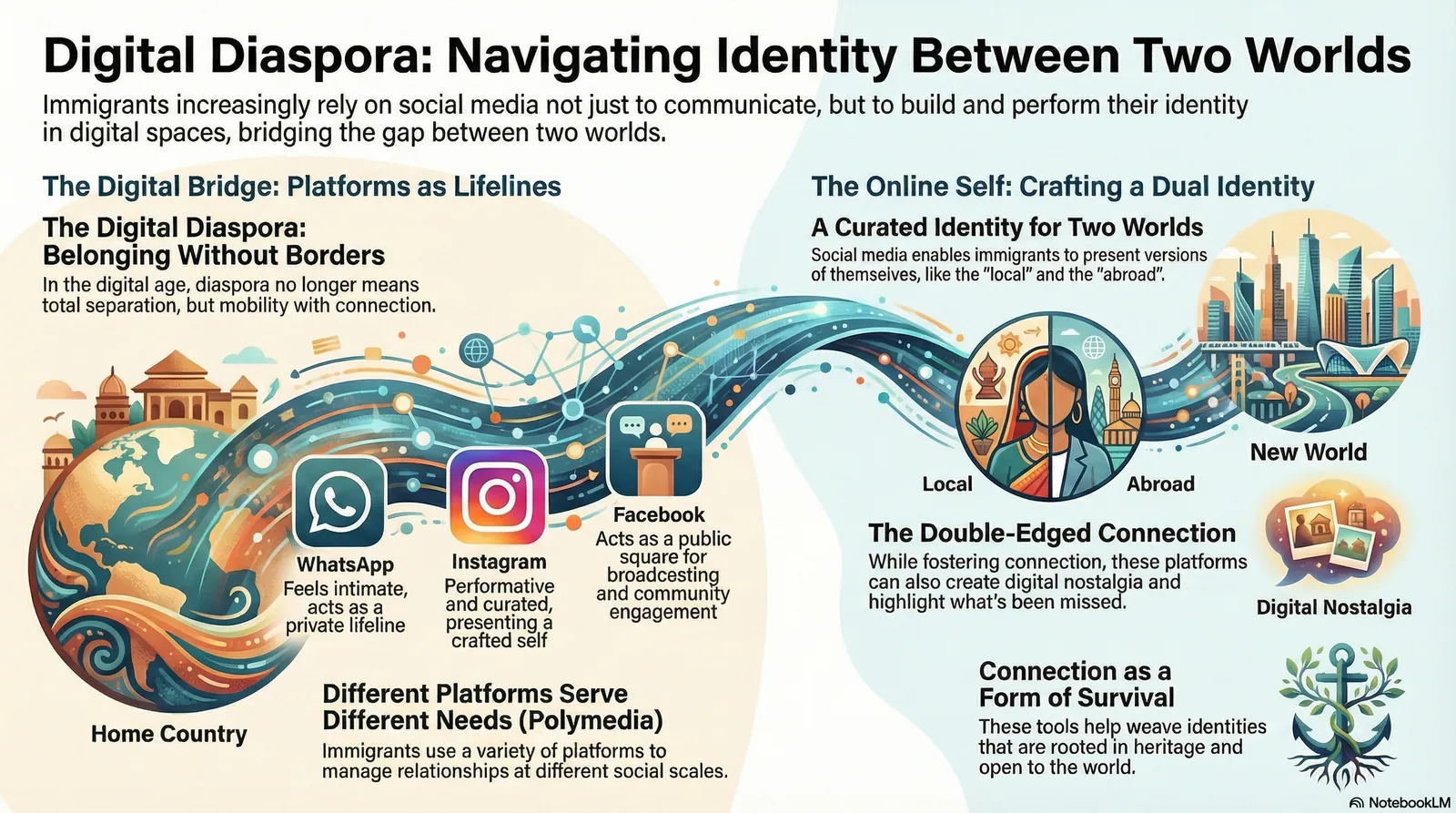
🌍 The Digital Diaspora: Belonging Without Borders
The word 'diaspora' once meant 'a scattered people', those who left their homeland, often by force or necessity. But in the digital age, diaspora no longer means total separation. It means mobility with connection.
Cultural theorists like Georgiou (2013) and Gilroy (1994) help me understand that the idea of diaspora isn’t just about leaving a place, but about carrying your “roots” with you as you navigate new “routes”; a simultaneous journey where you’ve been and where you’re going.
Today, this connection flows freely through social media platforms. This fluid way we use different platforms like WhatsApp for intimate family chats and Instagram for curated glimpses of life. This is what anthropologists like Miller and Madianou (2013) call scalable sociality and polymedia. It’s exactly how I’ve found myself navigating my connections.
For example:
- WhatsApp feels intimate, a place for family audio and group chats where language and laughter stay alive.
- Instagram feels a personal curated gallery of your "best" moments.
- Facebook, which I’ve since left, once felt like a public square, great for connection but crowded with noise and nostalgia.
I see these platforms as a digital neighbourhood, where some neighbours open their doors and others closed them. Together these online platforms creates a transnational sense of home.
👤 The Online Self: How We See Ourselves Through Screens
When I first arrived in the UK, I start to post photos online more often, what I noticed that I wasn’t not only sharing my special days. I was presenting a version of myself. Sometimes it was the “London local,” strolling through Camden Market; other times it was the “Brazilian abroad,” enjoying a day on the beach.
Social media enables immigrants to design their identities that feel both real and fictional. This process, which anthropologists call “personhood”, how individuals express themselves through social interactions and connections (Mauss, 1986; Strathern, 1988).
Instagram, in particular, becomes a stage where our individual identity is performed. The likes, comments, and stories we share aren’t just updates; they’re elements of a carefully curated self, reflecting how we aspire to be perceived.
For immigrants, this takes on an emotional layer. We just don’t show who we are online at the moment, but we reconnect with who we were in the past. We preserve the language, humor, and values that run the risk of disappearing in a foreign culture by sharing songs, jokes, and images from home.
I’ve noticed this dual identity in myself: the Carioca (from Rio) who laughs listening a home joke on WhatsApp, and the Londoner who writes reflectively in English. Both are me, but they coexist differently depending on the platform and the people.
💬 Case Studies: Community, Expression, and Resistance
My personal journey resonates with countless others, as digital anthropology research consistently shows this global pattern of migrants using social media to express themselves, reconnect and overcoming loneliness.
For instance:
- Eritreans in the diaspora use online platforms like Dehai.org (opens in a new tab) as a digital public square to share news and debate politics that they can’t discuss openly at home (Bernal, 2006).
- Paraguayan migrants build online communities like Cibervalle to offer guidance, assist newcomers, and organise cultural events (Greschke, 2012).
- Filipina mothers working abroad retain emotional intimacy with their children using webcams and Skype. This powerful connection, where mothers bridge vast distances to nurture their children, is what Madianou and Miller (2013) call transnational motherhood, a testament to love transcending physical absence.
These examples highlight how social media empowers individuals to reclaim and reconstruct their identities, cultures, and family ties across borders, transforming technology into a powerful force for resilience.
I see this every time I open WhatsApp. My family group chat is more than simply a series of messages; it’s a virtual living room sofa where life unfolds through emojis, images, and audio. I feel like I’m back home for a little while after some friend sends a carnival video or gives me the latest news about Rio.
🕊️ The Emotional Side: Nostalgia, Belonging, and the “In-Between”
The digital connection isn’t the same as physical presence. There’s always a gap, a kind of digital nostalgia. I feel it when I hear the sound of waves from Ipanema on a video my best friend sends, or when I scroll through friends’ pictures celebrating birthdays I missed. These moments are bittersweet. They provide joy while also serving as a reminder of what I am missing over there.
Researchers like Elaheh Farmand (YouTube, 2020) describe this feeling beautifully in her blog Bluebird Escape, where she talks about seeing traces of Tehran in her new American city: smells, streets, and small shops that trigger sensory memories. I understand that. Sometimes, London surprises me the same way when I found a Brazilian café hidden in Tooting Market, with samba music playing in the distance.
These online and offline sensory experiences help me grasp what anthropologists call ‘transnational embodiment’, the profound idea that our memories and emotions aren’t left behind. They travel with us, shaping our present wherever we are.
Because of this, I believe that a large number of immigrants live in what I refer to as ‘the in-between space’. It is a psychological and emotional space that lies between their home country and their new one. Social media makes that distance manageable, but it doesn’t completely eliminate it.
⚖️ Identity Across Platforms: A Performing Act
The fact that every social media site delivers a unique emotional temperature.
- WhatsApp feels warm and intimate: close family, private jokes, and daily updates.
- Instagram is performative: filtered moments of success or beauty and is a place to celebrate identity.
- Facebook can be political, where diaspora voices find power, visibility, and sometimes solidarity.
This ability to ‘zoom’ our social circles from the intimate family chat to a global audience, as anthropologist Costa et al. (2016) describes with ‘scalable sociality,’ is incredibly powerful for migrants.
This flexibility is crucial for migrant. We constantly shifting between visibility and privacy, home and host country, belonging and becoming. There are layers of identity work in every post, comment, or message, including self-assertion, familial reassurance and, social adjustment.
💡 My Insight: Connection as a Form of Survival
After living in London for over ten years, I consider social media as a coping mechanism as well as an useful technology tool. By connecting the person I was in Rio with the person I’ve become in London, it’s how I’ve managed to keep my sense of continuity.
I no longer use Facebook; its noise started to drown the intimacy I valued. Instead, WhatsApp and Instagram feel like my twin anchors. One keeps me grounded in family; the other lets me express my evolving identity.
But this connection is double-edged. I also believe that staying too close to the past can make it more challenging to focus on the present moment. The constant scroll between Brazilian and British worlds can blur where “home” really is.
And maybe that’s the point. For many of us in the diaspora, home is not a place. It can be an online environment. It’s the digital elements that connect us across continents and time zones.
🌐 Why This Matters
During my master’s degree in digital humanities, I found that understanding how migrants uses social media was more than just an academic exercise. Millions of individuals are reconsidering belonging in the 21st century through it.
These platforms:
- They give a platform to voices often silenced or ignored by traditional media.
- They open up new ways to feel like a citizen, to participate in culture, no matter where you are.
- They help us weave together identities that are both rooted in our heritage and open to the world, blending the digital with our lived reality.
Nevertheless, it also exposes us to new challenges such as performative identity, living a digital fatigue due to overload information. Navigate these worlds without losing oneself is a challenge for migrants.
💬 Conclusion: Between Connection and Transformation
The ability to be present in both places at once is something that social media has made possible for the global diaspora. It enables us to express multiple, layered, and dynamic identities and, preserving connections that would have otherwise dissolved.
As a Brazilian immigrant residing in the UK, I see my online presence as a daily dance between becoming and belonging, a form of cultural choreography. Every message to my loved ones on WhatsApp, every story shared from the other side of the Atlantic, is part my personal journey.
Beyond all the theories and technological marvels, one fundamental human truth remains: it is connection, in its purest form, that truly allows us to bridge and endure the vastness of distance.
In this sense, the internet isn’t just wires and screens. It’s the new heart of the diaspora, beating in sync across time zones, reminding us that even when we move far from home, we never truly leave it behind.
👀 Sources:
Bernal, V., 2006. Diaspora, Cyberspace and political imagination the Eritrean diaspora online, Global Networks 6, 2 (2006) pp. 161-179.
Costa, E., Miller, D., Haynes, N., McDonald, T., Nicolescu, R., Sinanan, J., Spyer, J. and Venkatranman, S., 2016. How the World Changed Social Media, UCL Press. pg. 3.
Elaheh Farmand (YouTube, 2020) Immigrants & Exile: Stories of Nostalgia & Longing. September. Available at: https://www.youtube.com/watch?v=JOy7ULGdieQ (opens in a new tab) (Accessed: November 2025).
Georgiou, M., 2013. Diaspora in the Digital Era: Minorities and Media Representation, Journal on Ethnopolitics and Minority Issues in Europe. Vol 12, No 4, pp. 80-99.
Gilroy, P., 1994. Diaspora. Paragraph, 17(3), pp.207-212.
Greschke, H. M., 2012. Is There a Home in Cyberspace?: The Internet in Migrants’ Everyday Life and the Emergence of Global Communities, Routledge. pp. 3-5.
Mauss, M., 1986. A Category of the Human Mind: the Notion of Person; the Notion of Self. In The Category of the Person. Anthropology, Philosophy, History, Cambridge University. Press, pp. 1-25.
Mirca, M. and Miller, D., 2013. Migration and New Media: Transnational Families andPolymedia, New York: Routledge. pg. 75.
Strathern, M., 1988. The gender of the gift: problems with women and problems with society in Melanesia (Vol. 6). Univ of California Press.
[Disclaimer: ChatGPT helped me polish this article, but the core messages were all initially developed through my work within the Anthropology of Social Media in the MSc Digital Humanities.]