
Understanding Information
Last Modified:
A deep dive into the transformation of data into wisdom and the various frameworks we use to comprehend information in the digital age.
From Data to Wisdom and Worlds of Knowledge. How We Understand Information
When you think about "information", what comes to mind? Perhaps it’s the flood of facts on the Internet, the data your phone collects, or the books lining a library shelf. Despite being so central to our lives, information is surprisingly difficult to define.
As a front-end engineer, I’m constantly fascinated with how humans and machines transform raw input into meaningful understanding. This fascination often leads me back to two powerful and contrasting theories in information science: the DIKW hierarchy: Data, Information, Knowledge, Wisdom by Russel Ackoff (1989), and Karl Popper’s Three Worlds (1972 and 1978).
Both theories tackle the same fundamental question: how does information evolve into knowledge? but from completely different perspectives. One envisions a ladder we climb, while the other overlaps a picture of three interconnected worlds that we live in. Inferring both has profoundly influenced not only my understanding of data but also how I engineer digital systems for people, because at its core, information isn’t merely about bytes and algorithms; it is about meaning.
🧩 The DIKW Pyramid: From Raw Data to Human Wisdom
The DIKW pyramid finds its poetic genesis in T.S. Eliot’s (1934) famous question:
Where is the wisdom we have lost in knowledge?
Where is the knowledge we have lost in information?
Decades later, in the 1980s, system theorist Ackoff (1989) transformed this poetic lament into a structure model, illustrating data’s ascent through a clear hierarchy—from raw input to meaningful output.
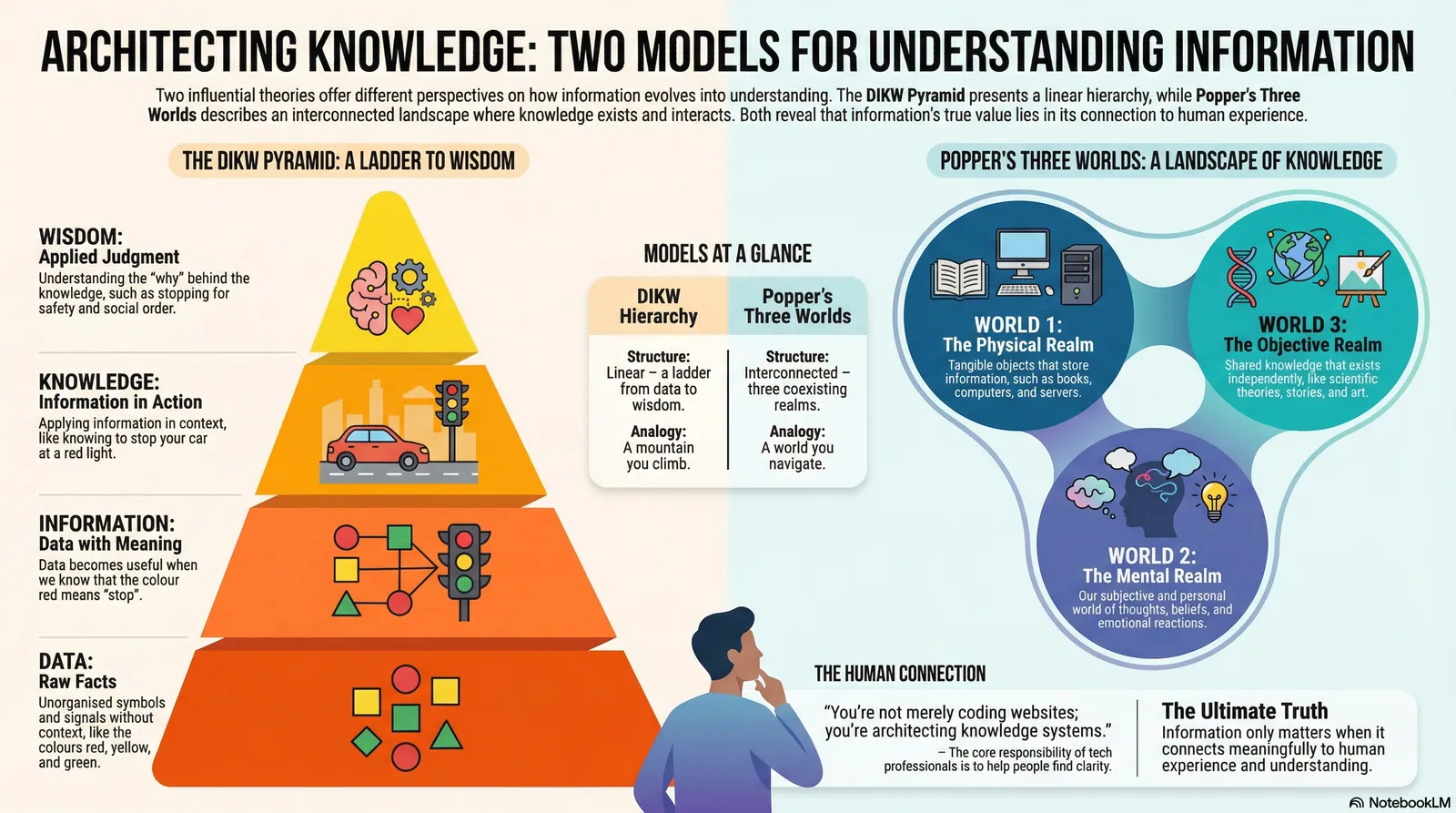
Imagine the DIKW model as a journey up a mountain:
- At the base is Data — numbers, symbols, or facts without context. Think of traffic light colours: red, yellow, green floating on a screen.
- The next layer is Information, where data gains meaning. Now we know “red” means "stop".
- Then comes Knowledge, where context enters the picture. You’re driving, you see a red light, and you understand you must stop here and now.
- Finally, at the top is Wisdom, where knowledge turns into action. You decide to stop because you know it’s safer and socially right.
What I like most about DIKW is its simplicity. It explains how raw data becomes something we can actually use. In my work with user interfaces, dashboards and APIs, I see this transformation constantly. Data alone is just noise, but when I present it in a structured way with context, aligning with a clear purpose, that’s when I can build truly human-centred technology.
Still, DIKW isn’t perfect. It assumes a clean, linear progression from one layer to the next, as if knowledge always “levels up” neatly. Real life is messier. Information doesn’t always flow upward; it loops, evolves, and sometimes even contradicts itself.
When I build web systems, for example, users often create new data (comments, interactions) that reshapes the “knowledge” layer dynamically. It’s less a pyramid and more a living ecosystem, one where meaning shifts depending on perspective and context.
🌍 Popper’s Three Worlds: Where Knowledge Lives
Popper (1978) has a different view than a linear ladder; he imagines three interconnected worlds that coexist and constantly interact.
- World 1: The physical world — everything tangible: books, computers, neurones, and digital files.
- World 2: The mental world — thoughts, feelings, beliefs, and subjective understanding.
- World 3: The world of objective knowledge — the content that exists once ideas leave our minds and enter shared forms, like art, science, or literature.
Here’s a simple analogy: Take Shakespeare’s Romeo and Juliet.
- The book on your shelf is World 1, the physical object.
- Your personal reaction: the emotion, reflection, or interpretation is World 2.
- The story itself, its plot, themes, and language that exist regardless of who reads is World 3.
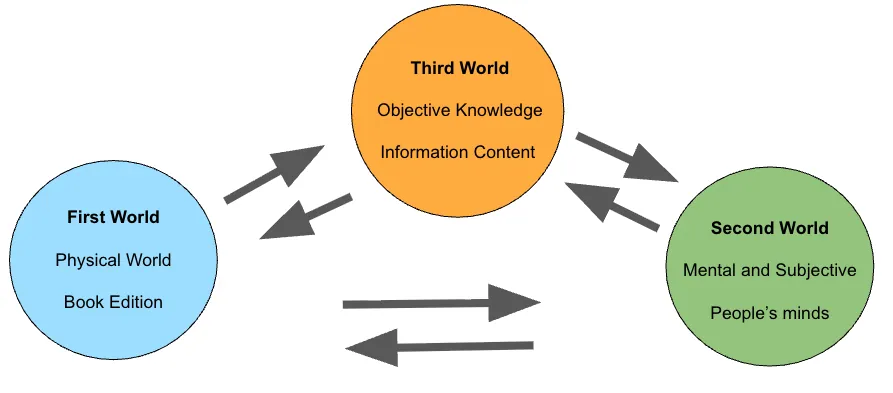
Popper's Three Worlds. Created by the author.
Popper’s (1978) concept is truly radical because it posits knowledge as something real and independent, existing beyond the confines of individual minds. The moment an idea is articulated, shared, or stored, it enters an ever-expanding ‘World 3’, a collective repository that others can access, critique, and build upon.
As Popper (1972) famously stated:
We are fallible and prone to error, but we can learn from our mistakes"
He saw knowledge not as static truth but as something that evolves through relentless criticism and correction, much like Darwinian natural selection. A theory holds its ground only until a more robust idea emerges to challenge and replace it.
⚖️ Comparing the Two: Ladder vs Landscape
Aspect | DIKW Hierarchy | Popper’s Three Worlds |
|---|---|---|
Structure | Linear – data to wisdom | Interconnected – three coexisting realms |
Focus | Transformation of data | Nature and existence of knowledge |
Strength | Clear, visual, practical | Philosophically deep, integrates cognition |
Weakness | Oversimplifies complexity | Abstract, difficult to visualise |
Analogy | A mountain you climb | A world you navigate |
The DIKW model deeply resonates with engineers because it offers a structured, actionable, and measurable framework. It helps us to understand how raw data can drive powerful decisions. I consistently apply its logic when building the design into a landing page, meticulously crafting semantic page elements that guide users to get a profound insight.
Conversely, Popper’s model truly comes alive when I consider the nuances of meaning and the spark of creativity. It effectively shows the flow of knowledge between people’s thoughts, different media, and the wider society. For instance, when I create my personal website, I’m not just sharing my professional journey online; I’m actively contributing to World 3, the ever-expanding, collective body of digital knowledge. Someone else might then interpret it through their unique lens (World 2) and), implement it in a tangible project (World 1), and thus, the dynamic cycle continues.
The two theories, then, don’t cancel each other out; they complement each other. DIKW helps us build systems that organise data efficiently. Popper helps us reflect on what those systems mean for human understanding.
💭 My Personal Insight: Why This is Important in Real Life
Initially, my studies in information science led me to view data and knowledge as purely technical challenges—neatly structured, easily controlled. But with experience, a profound realisation: they’re deeply human problems.
I work as a frontend engineer, which puts me right where these two models meet. Every interface I design, I’m actively transforming raw data (DIKW’s base) into comprehensible information (World 3 knowledge), effectively bridging Popper’s mental and objective worlds.
These models taught me a crucial sense of humility. Data reveals what is happening, but not why. While information can help, only human wisdom, which comes from understanding and having lived experiences, can really help us make decisions.
Information can enlighten, but only human wisdom, forged from empathy and lived experience, can truly guide our decisions.
This distinction is more important than ever in the era of artificial intelligence and algorithms. Systems all around us produce vast amounts of data, but they are incapable of making decisions. Without human interpretation, the vital light of our world's minds, the DIKW pyramid remains a lifeless structure.
One of my favourite Popperian ideas is that knowledge is never final; it’s always in motion, open to challenge and reinterpretation. That feels profoundly true in today’s digital landscape. At its best, the web is a living example of World 3, a place for everyone where ideas are developed by discussion and criticism.
🔍 Why These Theories Still Matter Today
In a world driven by information, these theories remind us that not all knowledge is equal.
- DIKW helps us manage complexity. It’s how we design better data systems, create smarter apps, and make the web usable.
- Popper helps us question assumptions. It acts as a reminder that every dataset, algorithm, and digital choice has a human history, bias, or belief.
Ultimately, both theories invite us to view information not as static 'stuff', but as living knowledge, a dynamic entity constantly shaped by our engagement, our sharing, and our relentless questioning.
The main message for those who start this career as a junior developer is, "You're not merely coding websites; you’re architecting knowledge systems.” Every layout, every label, every line of code carries the profound responsibility of helping people navigate the world’s inherent complexity with greater clarity.
And that’s where DIKW and Popper meet again: at the point where clarity meets curiosity.
🧠 Conclusion: Information as a Human Adventure
Ackoff (1989) and Popper (1972 and 1978), through approaching information from distinct structural and philosophical points of view, ultimately converge on a singular, powerful truth: information only matters when it connects meaningfully to human experience.
These theories are more than just theoretical frameworks to me; they serve as a lens through which I view society, technology, and design. DIKW reminds me that clarity can be built. Popper reminds me that understanding must always stay open.
In this digital age—where we now generate more data in a single second than humanity ever created in an entire century, perhaps true wisdom isn’t found in accumulating more facts. Rather, it is the ability to distinguish what to preserve, what to question, and what to share thoughtfully.
Or, as T.S. Eliot (1934) might still ask us today:
Where is the wisdom we have lost in knowledge?
Where is the knowledge we have lost in information?
👀 Sources:
Ackoff, R.L., 1989. From data to wisdom. Journal of Applied Systems Analysis, 16(1), pp.3-9.
Eliot, T.S. (1934) The Rock. Those lines come from the poem “The Rock” by T.S. Eliot.
Popper K., (1972). Objective knowledge: An evolutionary approach. Oxford, UK: Clarendon Press. – p.64, p.265, p.109, 1978.
Popper, K. (1978). Three worlds: The tanner lecture on human values. Ann Arbor: University of Michigan.
[Disclaimer: ChatGPT helped me polish this article, but the core messages were all initially developed through my work within the Information Science in the MSc Digital Humanities.]